

The Column · October 2026
What Potential Needs to Become Real
Potential rarely looks like proof. Before an idea, a book or a career is worth amplifying, someone has to notice it, name it and give it structure – and that order matters more than the volume.
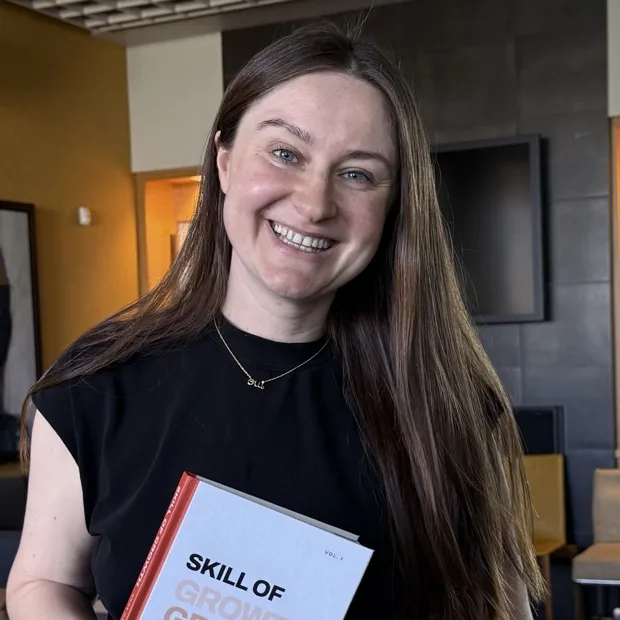

A while ago I was working with an author who had years of experience behind her, dozens of stories, and easily enough material for more than one book. Still, she kept telling me she wasn't sure she had enough to say. As I listened, I had a feeling I've learned to trust over the years: there was something here. It wasn't a finished book yet, and she didn't have a clear thesis, but it was worth looking for.
I've had versions of that moment throughout my career. It happens with experts who know far more than they can put into words, and it happens a lot with founders who come to me for marketing help when their real issue is positioning. Some people can walk me through every job they've held and still go quiet when I ask what they want next. At some point, I had the same conversation with myself.
For years, I described my work through a rotating set of titles: marketer, entrepreneur, coach, publisher. At times they felt almost unrelated, and I worried I had built a career pulling in too many directions. It took me a while to notice that while the titles kept changing, the question underneath them stayed the same.
I kept asking how something with potential turns into something real.
That question has run through nearly everything I've done, and over time it changed how I think about potential itself. I used to see it as a quality a person either has or doesn't. Now I think of it as something that depends on conditions. It needs language and some kind of structure, and eventually it needs someone willing to act on it. Without those things, potential tends to stay exactly where it is.
Potential rarely looks like proof
Potential is easy to see in hindsight. Once a company is growing, everyone agrees the idea was promising, and once a book does well, the author seems like an obvious bet. When someone has built an impressive career, it's easy to look back and string their decisions into a tidy story.
In real time, it looks much messier. It might be a manuscript that wanders, or a founder who can't explain the company in one sentence. Sometimes it's a career that doesn't fit any job title, or an idea someone keeps coming back to without knowing what to do with it. There's rarely any proof at that stage, which is exactly what makes it hard.
Seeing potential has little to do with predicting success. It means noticing that something valuable might be there before the evidence shows up, and then deciding whether it's worth the effort to develop.
Most experts already have enough to say
Publishing changed how I think about expertise. People tend to assume a book starts with having enough information, so they keep gathering more stories, research, frameworks, and credentials. In my experience, knowledge is rarely what holds them back.
I've worked with people who had a long career behind them and still couldn't tell me what their book was really about. They knew the topic well. What they hadn't found yet was their point of view. You can know hundreds of things without knowing which of them is yours to say, and you can have twenty years in a field without being sure what you believe strongly enough to defend.
That's usually where the real work starts. A book gets interesting when the author is willing to say what she has seen and what she has come to believe because of it.
I started noticing the same thing outside publishing. Founders tell me they need more marketing, and professionals assume the next credential will be the thing that unlocks their career. Sometimes that's true. More often, though, the harder question is what they already know and are finally ready to stand behind.
Before you amplify an idea, you have to know what the idea is.
Notice, name, structure, amplify
Over time, I started thinking about growth in four stages: notice, name, structure, amplify. I don't treat it as a rigid method. It's more a pattern I kept running into across very different kinds of work.
Everything starts with noticing. Before something can grow, someone has to see that it's there, whether that's a strength, a recurring idea, an unmet need in a market, or a person who can do more than their current role allows. It sounds simple, but we're surrounded by signals, and most of them are noise. The first skill is learning which ones deserve a second look.
Naming comes next, because it's hard to develop something you can't put into words. An expert can have enormous knowledge and no language for the idea that ties it together. A founder can understand a product inside out and still fail to explain why anyone should care. Putting something into words turns an intuition into something you can examine, and this is usually where a point of view begins.
Then the idea needs structure. A manuscript has to become a book, expertise becomes a framework, a business idea turns into an offer, and a vague ambition turns into a plan. Potential without structure can stay potential forever, and structure is also what makes growth repeatable.
Amplification comes last. This can mean marketing, distribution, PR, content, community, or scale, and it's the stage most people want to start with because it's the most visible. The problem is that amplification doesn't fix a weak idea. It just shows the weakness to more people. Marketing can't rescue positioning that was never clarified, and a bigger audience won't hand you a point of view. Scale is powerful once there's something worth scaling.
Applying it to myself
Patterns are always easier to see in someone else's work. For a long time, my own career was the hardest thing for me to explain, and every new chapter seemed to make the story more complicated. The usual advice is to pick a niche and make yourself understandable in one sentence. There's value in that, but I came to believe that simplifying doesn't have to mean cutting away parts of yourself. Sometimes it means finding the thread that connects them.
My work had never really been about one industry. It had always been about growth, and specifically about the stage before growth becomes obvious, when something valuable exists but hasn't taken shape yet. That might be a business that needs sharper positioning, an expert who needs language for what she knows, or an author looking for the idea inside her manuscript. It might also be a woman who can sense she's ready for a bigger life but can't describe it yet.
Once I saw that, my career finally made sense to me. I had been approaching one question from several directions all along.
Being seen
Some of the most important people in my life weren't the ones who gave me the best advice. They were the ones who saw something in me before I had words for it, and that has stayed with me. Praise tells someone they're doing well, while really seeing someone sometimes sounds more like "I think there's more here."
That doesn't mean empty encouragement, and it doesn't mean every idea is brilliant or every dream is worth pursuing. Often the most useful thing you can do is challenge an idea, and sometimes potential doesn't survive contact with reality. That's part of the process too. What's rare is attention that is both honest and patient: willing to ask hard questions and willing to stay with an idea long enough to help turn it into real work.
That's why I no longer describe my mission as believing in people. Belief on its own isn't enough. What I want is to help people make what's possible more visible and more precise, until it becomes real.
The idea I'm willing to stand behind
If I had to boil everything I've learned about growth down to one belief, it would be that potential doesn't turn into impact by accident. Someone has to notice it first. Then it needs language, then a structure, and only then, if it deserves to grow, amplification. The sequence plays out differently for a person, a book, a business, or an idea, but the principle holds: potential is where things start, and what matters is what gets built around it.
These days, when I meet someone with a half-formed idea, an unusual mix of experience, or an ambition they're almost embarrassed to say out loud, I still react the way I did with that author.
I think there's something here.
I don't always know what it will become, and usually neither do they. Maybe knowing isn't the job, and the job is to notice it early, name it clearly, and give it enough structure to find out.
In one form or another, that's the work I want to spend my life on: seeing potential and helping it grow.