

The Column · October 2026
AI Was Supposed to Give Us Our Time Back
AI made the work faster, but the hours it saves rarely stay empty. When possibility starts behaving like obligation, the harder question is not how much time we save – it's whether we know how to keep any of it.

A few weeks ago, I was watching one of those videos in which a founder explains how he has built a small army of AI agents to run different parts of his company.
There was a marketer, a copywriter, an analyst, an assistant, a designer, and several others passing work between one another in the background. The exact number did not really matter. What mattered was the implication: tasks that would once have required several people were now happening continuously, coordinated by one person.
I found it genuinely exciting. I also had the immediate, almost involuntary thought that I should understand how to do this too.
I have started recognizing that feeling very quickly. It is not quite anxiety, and it is not exactly fear of missing out either. It feels closer to being late for something, except there is nowhere specific I am supposed to be. There is simply a sense that something important is moving very quickly, that other people have already adjusted to it, and that perhaps I should be adjusting faster.
By the time I understand one tool, another appears. The technology is extraordinary, but what is equally extraordinary is how quickly extraordinary things begin to look normal.
We were told that AI would give us our time back. And technically, it does.
Tasks that used to take hours can now take minutes. Writing is faster, analysis is faster, design is faster, and a first draft of something that once required a specialist can appear on your screen before you have finished your coffee.
Bloomberg recently reported on Silicon Valley founders and tech workers who have become dramatically more productive with AI and, somehow, are working longer than before. One founder keeps more than half a dozen agents running almost constantly and described having vastly more output while also saying he had never worked harder. Others spoke about sixteen-hour days, working late into the night, and the peculiar fear that stepping away for even a short time means falling behind a technology that continues moving without them.
I found that strangely familiar.
There are things I used to give to other people almost automatically. I would brief a designer, send something to a copywriter, ask an assistant to help with a task, or go directly to a lawyer when I needed a first draft of a document I did not know how to structure myself.
Now I often start with AI. I can build a website myself, create graphics and social media materials, prepare presentations much more independently, draft a document before sending it to a lawyer for review, or deal with emails that might otherwise sit in my head for far too long.
In one sense, I am delegating more than ever. In another, I am doing more myself than I have in years.
That distinction took me some time to notice.
When I delegated something to another person, the task temporarily left my hands. I sent a brief and waited. There were delays, misunderstandings and rounds of feedback, and I was often impatient with all of it, but there was also something hidden inside that friction: distance. For a while, the task was no longer mine to actively hold.
AI removes almost all of that distance. I ask, and the answer comes back. I change something, and another version appears. I have another idea, so I test that too. The loop between imagining something and beginning to execute it has become so short that there is almost no natural pause between the two.
This is enormously empowering. It also does something strange to the mind.
Mine feels more permanently switched on.
An idea no longer has to wait until tomorrow, until the designer is available, until someone answers an email, or until I have the right software. I can try it immediately. There is something almost intoxicating about that immediacy: you think of something and, seconds later, there is a tangible version of the thought sitting in front of you.
And then you think of another thing.
This is where I keep returning to the original promise that AI would save us time, because I am no longer sure that saving time and creating space are the same thing.
Perhaps what these tools really give us is capacity.
If something that once took two days now takes two hours, the remaining time rarely becomes protected space. It becomes an opportunity to do something else. There is almost an invisible clause attached to every productivity tool: now that you can do it faster, you can do more.
And once we see that something is possible, it becomes surprisingly difficult not to treat it as expected.
The feed matters here, but mostly because it has become the conveyor belt on which the frontier keeps arriving. You open your phone to answer a message and encounter a new model, a new workflow, another example of somebody compressing hours of work into minutes.
The future used to feel relatively far away. Now it arrives several times before lunch.
And somewhere in that constant exposure, possibility starts behaving like obligation.
I could automate this becomes I should automate this. I could learn this becomes why haven't I learned this yet? What begins as curiosity can quietly become another measure of whether you are doing enough.
Ambitious people are particularly good at this. The same instinct that makes you curious, adaptable and willing to build something difficult can make every new capability look slightly like an assignment.
The problem is that possibility has no natural ceiling.
That may be why someone can be objectively more productive than ever and still feel permanently behind. We are no longer comparing ourselves only with other people. We are also confronted with an imagined version of ourselves who uses every available tool perfectly, automates everything repetitive and never seems to waste capacity.
Of course, that person does not exist.
But technology makes her feel theoretically possible.

For years, we have imagined technology as a way of eventually creating more room. We would automate the boring parts, eliminate unnecessary administration, and somewhere at the end of all this efficiency there would surely be more time for the things that cannot be compressed so easily: thinking, reading, having a conversation that does not need to lead anywhere, sitting with a question long enough for the first answer to stop looking interesting.
Instead, every gain in efficiency seems capable of raising the level of what counts as enough.
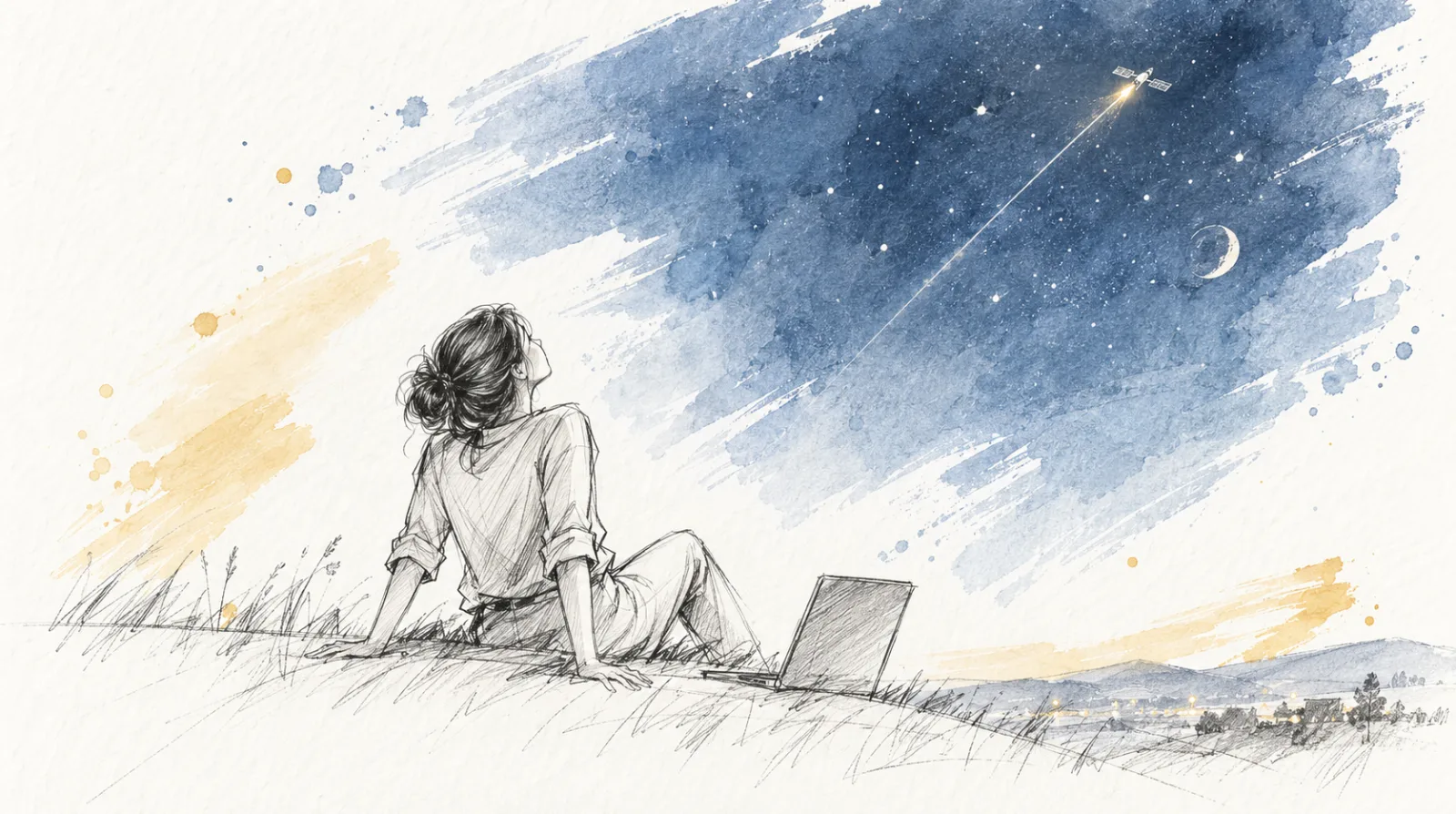
This does not make me anti-AI. Quite the opposite. I work in space tech, and I love technology. I still find it slightly unbelievable that humans put machines into orbit and receive information from them as though this were perfectly normal. AI gives me a similar sense of wonder. I want to understand it, use it well, and see what becomes possible because of it.
But I am becoming more interested in a question that sits underneath all this progress.
What exactly are we trying to save time for?
We spend enormous amounts of energy discussing how to save time and surprisingly little discussing what should happen once it has been saved.
If I automate three hours of work and immediately fill those three hours with three more hours of work, perhaps I have increased my output. Maybe I have saved money. Maybe I have built something better.
But have I gained time?
Or have I simply increased throughput?
The world really is moving quickly, and paying attention to that change is rational. But there is a difference between paying attention to the speed of the world and allowing the fastest-moving thing around you to determine the pace at which your entire life should be lived.
There will always be another model, another tool, another person who adopted it earlier, another thing you could be doing.
Perhaps one of the more important skills in this next phase of technology will not be learning how to do everything that becomes possible, but deciding which possibilities deserve to become part of our lives at all.
I thought again about that small army of AI agents.
I still think the system was brilliant, and I will probably experiment with some version of it myself. The difference is that the question I am interested in now is no longer only how many hours those agents could save me.
It is what I would actually do if they did.
Would I use the space to think better, read something slowly, spend longer with someone I love, or leave the hour empty long enough to discover what I wanted to do with it?
Or would I simply invent another project because an empty hour would somehow feel irresponsible?
We spent years waiting for technology powerful enough to give us more time.
It may finally be arriving.
I am beginning to think the harder question is whether we know how to keep any of it.